Share this guide
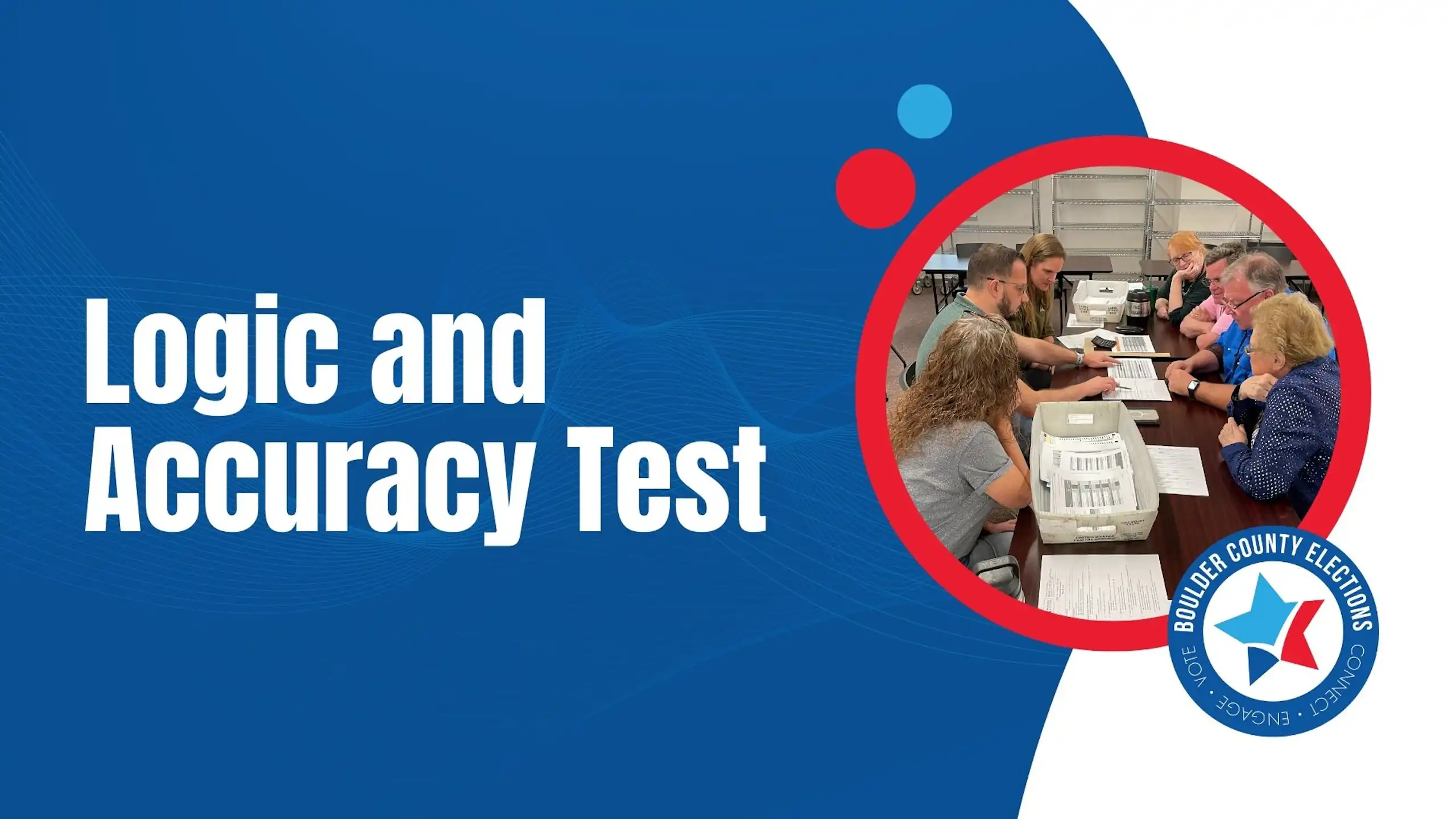
Link copiedLogic and accuracy testing, usually called L&A testing, is the pre-election process election officials use to check that voting equipment is functioning and configured correctly for a specific election. Officials load the election setup, cast a known pattern of test votes and compare the system's reported totals with the results they expect.
L&A testing is different from certification or acceptance testing. It asks an election-specific question: Will the equipment and ballot configuration prepared for this election capture and tabulate votes as expected before real voting begins?
What does logic and accuracy testing check?
A voting system can include hardware, software, ballot definitions, scanners, ballot-marking devices and tabulation components.
The U.S. Election Assistance Commission (EAC) describes pre-election testing, or L&A testing, as testing every ballot style and every component of the voting system before use. Its purpose is to detect malfunctioning equipment and improper election-specific setup.
That means the test checks both:
- Logic: whether the system contains the correct election information; and
- Accuracy: whether known test votes are captured, counted and reported correctly.
Why does each election need its own L&A test?
A certified voting system still needs new election-specific programming.
An election definition contains the contests, candidates, districts and ballot-style information for a particular election. A jurisdiction can also have many ballot styles because voters in different precincts or districts may be eligible for different contests.
L&A testing checks that actual configuration.
It can identify problems such as a missing candidate, a contest assigned to the wrong precinct, an incorrect vote-for limit, a scanner interpreting marks incorrectly, a ballot-marking device loading the wrong ballot or totals being reported incorrectly.
When does L&A testing happen?
The EAC recommends conducting L&A testing after ballots have been proofed and finalised but before voting begins.
Testing too early can miss the final configuration; testing too late leaves less time to correct problems before voting.
Election officials therefore include L&A testing among the jurisdiction's pre-election procedures. Exact timing and legal requirements vary by state.
How does logic and accuracy testing work?
The process is straightforward.
1. Prepare the election configuration
Officials finalise the ballots, load the election definition and identify the equipment that will be used at polling places, early-voting sites or central-count locations.
The test plan should cover the relevant ballot styles and the functions each device is expected to perform.
2. Create a known test pattern
Officials prepare a test deck: test ballots marked so the expected totals are known in advance.
EAC guidance recommends exercising every voting choice at least once and including conditions such as overvotes, undervotes and blank ballots where appropriate.
For hand-marked paper ballots, test decks can also include different kinds of marks or folds to check how scanners handle realistic ballot conditions.
3. Exercise the ballot styles and equipment
Testing only one sample ballot would not check all election programming.
For a ballot marking device, officials can confirm that the correct ballot appears, selections are captured and the expected paper ballot is produced.
For precinct scanners or a central tabulator, officials can scan the test ballots and confirm that marks are counted correctly.
EAC guidance also recommends testing accessible functions such as audio ballots and other features relevant to the equipment.
4. Compare the reported totals with the expected totals
Officials generate results from the test and compare them with the predetermined vote pattern.
If the totals match, the test provides evidence that the election configuration and tested equipment performed as expected under those conditions.
If they do not match, officials investigate the discrepancy.
5. Clear test data and secure the equipment
After successful testing, test results must not be mixed with real election data.
The EAC recommends closing the test session, confirming that later tabulation will not include test votes, clearly marking and storing test ballots, applying security seals and documenting seal numbers.
These steps connect L&A testing with configuration management and chain-of-custody controls.
What happens if the test finds a problem?
A discrepancy must be investigated.
Sometimes the cause is simple, such as a test ballot marked differently from the planned pattern. Other discrepancies can reveal incorrect election programming or malfunctioning equipment.
The EAC recommends documenting the cause. Equipment associated with an unexplained error may need to be replaced, maintained or investigated further before use.
If officials change the election configuration to correct a problem, the affected parts of the system should be retested according to the jurisdiction's procedures.
Finding problems before voting begins is one of the main purposes of L&A testing.
Is L&A testing the same as voting-system certification?
No.
Voting system testing for federal certification examines whether a defined voting system conforms to technical requirements such as the EAC's Voluntary Voting System Guidelines.
L&A testing occurs later, after election officials configure the system for a real election.
A useful distinction is:
Certification asks: Does this voting-system configuration meet the applicable technical standard?
L&A testing asks: Is the equipment prepared for this election set up and working as expected?
Certification therefore does not eliminate the need for election-specific testing.
Is L&A testing the same as acceptance testing?
No.
Acceptance testing normally occurs when a jurisdiction receives new or updated voting equipment. It checks whether the delivered equipment performs as required and corresponds to the system the jurisdiction purchased.
L&A testing is repeated as part of election preparation, even when the jurisdiction has owned the equipment for years.
Acceptance testing is about validating delivered equipment; L&A testing is about preparing equipment for a particular election.
Can the public observe L&A testing?
Often, but the rules vary.
The EAC recommends public notice of L&A testing and inviting media and candidate or political-party representatives to attend. Some states specifically require a public accuracy test or other observable pre-election test.
ESG defines a public test as an abbreviated L&A test announced publicly and open to attendance.
However, states differ on notice periods, observer access, bipartisan-team requirements and what parts of the testing process must be public.
What does a successful L&A test prove?
A successful test provides evidence that the equipment and election configuration tested produced the expected results under the test conditions.
It does not prove that equipment can never fail, that every security threat has been eliminated or that post-election auditing is unnecessary.
L&A testing is one layer of election assurance:
Certification → acceptance testing → election-specific L&A testing → secure operation → post-election verification
Each stage addresses a different question.
Do L&A requirements vary by state?
Yes.
States can specify which equipment must be tested, when testing occurs, who conducts or witnesses it, whether public notice is required, which ballot styles or conditions must be exercised, what records must be retained and how equipment is secured afterward.
There is no single federal L&A procedure that every election jurisdiction follows identically. The controlling requirements come from the relevant state and local election rules.
Related ESG terms
- Logic and Accuracy Testing
- Logic and Accuracy (L&A) Testing
- Election Definition
- Ballot Style
- Test Deck
- Voting System
- Voting System Testing
- Acceptance Testing
- Ballot Marking Device
- Central Tabulator
- Configuration Management
- Public Test
Frequently asked questions
1. Does logic and accuracy testing happen before every election?
Election officials conduct pre-election testing as required by their jurisdiction before equipment is used. Because ballot programming and ballot styles change between elections, a previous successful test does not substitute for checking the configuration prepared for the current election.
2. Are real voter ballots used during L&A testing?
No. Officials use test ballots or other test inputs with predetermined selections. The expected totals are known before tabulation, and EAC guidance recommends clearly marking and storing test ballots so they cannot be confused with actual election ballots.
3. Does L&A testing test every possible vote combination?
Not every mathematical combination. Test patterns are designed to exercise the relevant ballot positions, ballot styles, vote limits and conditions required by the jurisdiction so officials can check whether the configured system handles them correctly.
4. Is L&A testing a post-election audit?
No. L&A testing occurs before voting and checks equipment readiness and election-specific configuration. A post-election audit occurs after votes are cast and checks aspects of the reported results or election process. They provide different layers of verification.
Sources and further reading
- U.S. Election Assistance Commission — Logic & Accuracy Testing Quick Start Guide
- U.S. Election Assistance Commission — Election Management Guidelines
- U.S. Election Assistance Commission — Clearinghouse Resources on Election Technology
- U.S. Election Assistance Commission — ESTEP Guidance for Pre-Election Testing
- U.S. Election Assistance Commission — Voluntary Voting System Guidelines
ESG editorial note: Election Security Glossary is an educational and reference resource. It is not an election authority and does not provide legal advice or official voting instructions. Pre-election testing requirements and public-observation rules vary by jurisdiction; consult the relevant election authority for requirements that apply to a specific election.